Common Objections
Common Objections

Common Objections

Romans 3:23 says everyone has sinned, including Mary
At first glance, that seems like a compelling objection. How can the Catholic Church teach that Mary was sinless when Paul explicitly says that “all have sinned” (Romans 3:23)?
To understand what Paul meant, we need to look at the context. Throughout the opening chapters of Romans, Paul argues that both Jews and Gentiles are guilty of sin and in need of salvation. In Romans 3:9, he writes, “We have already made the charge that Jews and Gentiles alike are all under sin.” Then, in verses 22–23, he concludes, “There is no difference between Jew and Gentile, for all have sinned and fall short of the glory of God.”
Paul’s point is that no nation or people possesses an exemption from sin simply because of its religious heritage. Jews and Gentiles alike need a savior. But does this mean that every individual human being, without exception, must have personally committed sin?
Obviously not. Jesus himself was fully human, yet Scripture tells us that he was “without sin” (Hebrews 4:15). Infants, too, have committed no personal sins, since they have not yet developed the capacity to make morally responsible choices. This does not mean they are free from original sin, but it does demonstrate that not every human being has personally committed a sin.
Of course, Jesus is a unique exception because he is God incarnate. But the fact that his sinlessness is unique in its cause does not establish that God could not preserve another human being from sin by a special act of grace.
Catholics do not claim that Romans 3:23 teaches Mary’s sinlessness. We simply maintain that it does not rule out the possibility that God made an exception in her case. Whether he actually did so is a separate question.
Mary’s preservation from sin
Catholic teaching actually involves two related claims: that Mary was preserved from original sin from the first moment of her conception, and that she remained free from personal sin throughout her life. Both were gifts of God’s grace, made possible by the merits of Jesus Christ.
Regarding Romans 5:12 (“Therefore, just as sin entered the world through one man, and death through sin, and in this way death came to all people, because all sinned”), it is certainly true that human beings ordinarily inherit original sin from the beginning of their existence. Had God not intervened, this would also have been true of Mary. Likewise, human beings who reach the age of moral responsibility ordinarily commit personal sins. Again, had God not intervened, this would also have been true of Mary.
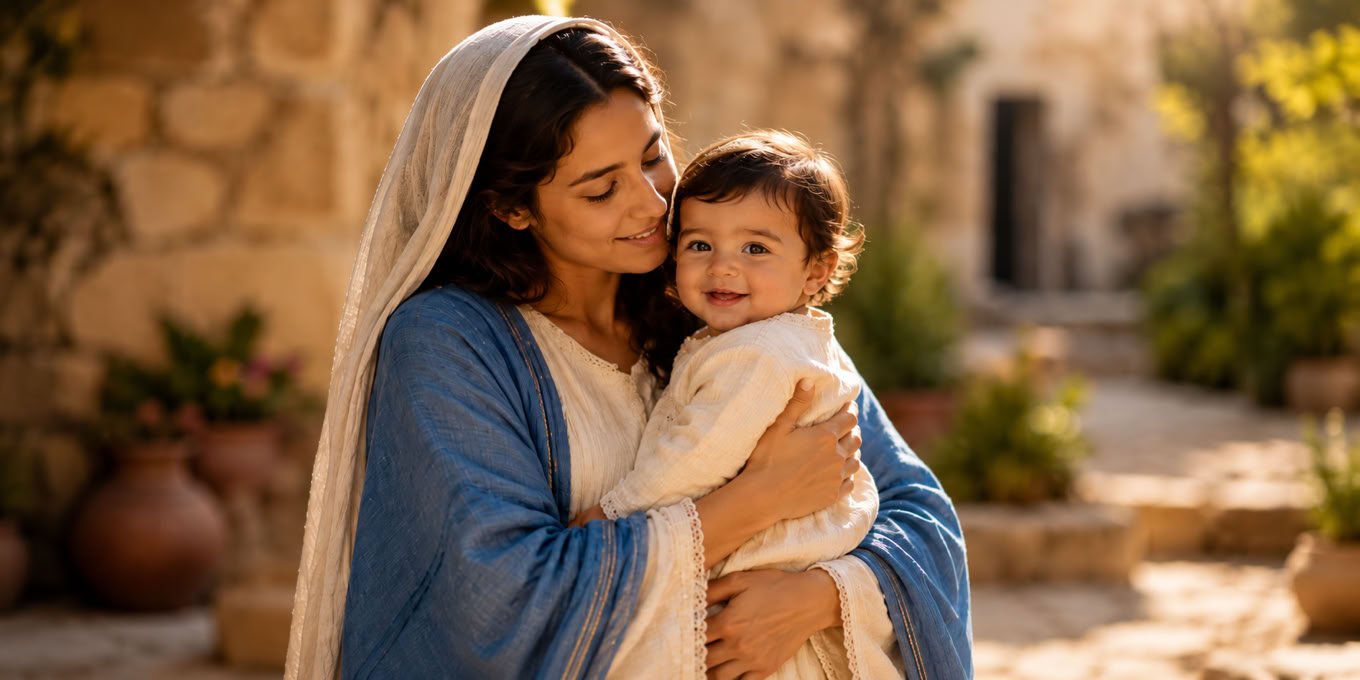
But there was nothing ordinary about the role Mary was given. She was chosen for a unique place in salvation history: to bear and give birth to the Son of God. It was her hands that fed him, that taught him to walk. It was her voice that taught him to speak. It was her arms that held him.
Catholics believe that God gave Mary gifts appropriate to her role as Jesus’ mother. It was not intrinsically necessary that she be preserved from sin, but it was fitting that the woman chosen to bear the Son of God should be endowed with exceptional holiness. As the Protestant reformer Ulrich Zwingli is reported to have said, “It was fitting that such a holy Son should have a holy Mother.”1
Mary needed a savior, too
Mary’s preservation from sin was a gift, based entirely on the merits of her Son. She was as much in need of a savior as the rest of us; she was just saved in a different way than the rest of us.
There are two ways to save someone from a pit. You can pull them out after they’ve fallen in, or you can prevent them from falling in in the first place. God saves us by pulling us out of the pit of sin. He saved Mary by preventing her from falling in. In both cases, it is God who does the saving.
Mary herself proclaimed, “My spirit rejoices in God my Savior” (Luke 1:47). Some Christians argue that this proves she must have been a sinner. But the Catholic Church has never taught that Mary did not need a savior. On the contrary, she was saved by Jesus Christ in a particularly remarkable way. God preserved her from sin through the merits of the very Son she would bear. So it is entirely appropriate for Mary to call God her savior, for he saved her in a most extraordinary way.
What did the early Christians believe?
The belief that Mary was exceptionally holy and free from personal sin is not a medieval invention. As early as the second century, Christian writers such as Justin Martyr and Irenaeus compared Mary with Eve, who had been created without sin. Just as Eve’s disobedience contributed to humanity’s fall, Mary’s obedience played a unique role in God’s plan of redemption.
Although these early comparisons did not explicitly teach the Immaculate Conception as later defined by the Catholic Church, they established an important theological foundation for the development of Marian doctrine.
In subsequent centuries, Christian writers made increasingly explicit statements about Mary’s freedom from sin. For example, Ephrem the Syrian wrote:
You alone and your mother are more beautiful than any others, for there is no blemish in you nor any stains upon your mother. Who of my children can compare in beauty to these?2
Ambrose of Milan similarly described Mary as a virgin free from every stain of sin:
Come, then, and search out your sheep, not through your servants or hired men, but do it yourself. Lift me up bodily and in the flesh, which is fallen in Adam. Lift me up not from Sara but from Mary, a virgin not only undefiled but a virgin whom grace had made inviolate, free of every stain of sin.3
Augustine was particularly explicit about making an exception for Mary when discussing personal sin:
Having excepted the holy virgin Mary, concerning whom, on account of the honor of the Lord, I wish to have absolutely no question when treating of sins—for how do we know what abundance of grace for the total overcoming of sin was conferred upon her, who merited to conceive and bear him in whom there was no sin?—so, I say, with the exception of the Virgin, if we could have gathered together all those holy men and women, when they were living here, and had asked them whether they were without sin, what do we suppose would have been their answer?4
These passages do not establish that the early Christians understood the Immaculate Conception precisely as the Catholic Church would later define it. They do, however, demonstrate that Mary’s exceptional holiness, and particularly her freedom from personal sin, had a prominent place in early Christian thought.
What did the Protestant Reformers believe?
It may surprise some modern Protestants to learn that Reformers such as Zwingli and Martin Luther expressed remarkably favorable views of Mary’s holiness.
Martin Luther, for example, expressed the belief in a sermon delivered in 1527 that Mary had been purified from original sin at the infusion of her soul. Although this reflected a medieval understanding of conception and was not identical to the doctrine later defined by the Catholic Church, his words are striking:
It is a sweet and pious belief that the infusion of Mary’s soul was effected without original sin; so that in the very infusion of her soul she was also purified from original sin and adorned with God’s gifts, receiving a pure soul infused by God; thus from the first moment she began to live she was free from all sin.5
Luther’s views on this question have been the subject of scholarly debate, and this passage should not be taken to mean that he consistently taught the Immaculate Conception in precisely its modern Catholic formulation. Nevertheless, it illustrates that belief in Mary’s extraordinary holiness was not confined to Catholics, even during the Reformation.
Does Romans 3:23 disprove Mary’s sinlessness?
No. Paul was explaining that Jews and Gentiles alike are sinners in need of salvation, not addressing whether God could preserve someone from sin by a special act of grace.
Catholics do not believe that Mary was sinless because the Church, carried away by its devotion to her, gradually elevated her to an almost divine status. We believe that God preserved her from sin by an extraordinary gift of grace through the merits of Jesus Christ.
Whether God actually granted Mary this extraordinary grace is a question that must be answered on other grounds. Romans 3:23 does not settle it.
__________
1 Eduard Stakemeier, De Mariologia et Oecumenismo, K. Balić, ed. (Rome, 1962), 456. The quotation is attributed to Ulrich Zwingli in this secondary source.
2 Ephrem the Syrian, Nisibene Hymns 27:8 (ca. A.D. 361). https://tianmu.org/good-work-library/christian/syriac-christianity/ephrem-hymns-on-nisibis/hymns-on-nisibis-xxvii
3 Ambrose of Milan, Exposition of Psalm 118 22.30 (ca. A.D. 387).
4 Augustine of Hippo, On Nature and Grace 36.42 (A.D. 415). https://www.newadvent.org/fathers/1503.htm
5 Martin Luther, sermon for the Feast of the Conception of the Mother of God (1527), in D. Martin Luthers Werke: Kritische Gesamtausgabe (Weimarer Ausgabe), vol. 17, part 2, 287–288.
Featured Articles
Copyright © 2024–[YEAR] Catholicoutlook.me