Common Objections
Common Objections

Common Objections

Catholics worship statues
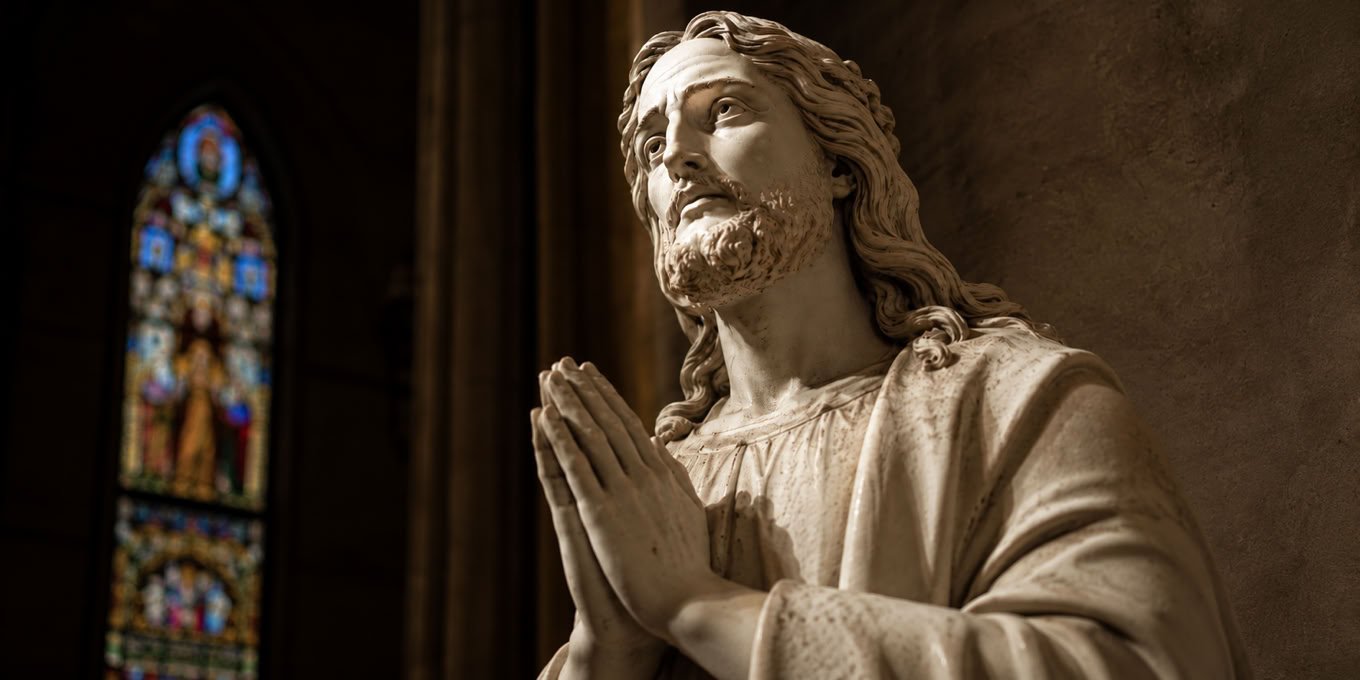
One of the first things you might notice upon entering a Catholic church is the statues—statues of Jesus, statues of Mary, statues of various saints. If you come from a church that is spare in its use of religious imagery, these statues might make you feel uncomfortable. You may even accuse the Catholic Church of idolatry and disobedience. After all, doesn’t the Bible forbid the use of any and all images?
Well, let’s look at exactly what the Bible says:
Thou shalt not make unto thee any graven image, or any likeness of any thing that is in heaven above, or that is in the earth beneath, or that is in the water under the earth. Thou shalt not bow down thyself to them, nor serve them. (Exodus 20:4–5, KJV)
If we interpret these verses as an absolute prohibition against making images, then even the simple wooden crosses that adorn many Protestant churches would be forbidden. Indeed, any sculpture whatsoever, no matter how secular, would be forbidden. No birds, no fish, no nothing. Michelangelo’s David would be as much an abomination as the golden calf (Exodus 32:4).
In fact, if you’re an American, and if you have an old quarter in your pocket, you may well be violating an excessively literal interpretation of the Second Commandment yourself. If you take out that quarter and look at the back of it, you might see embossed thereon a graven image of an eagle, ancient symbol of the pagan god Jupiter!
Fortunately, the Bible itself does not support such a strict interpretation. There are, after all, perfectly legitimate uses of sculpture found in the pages of the Old Testament. For example, King Solomon’s throne had armrests on both sides of the seat, “with a lion standing beside each of them” (2 Chronicles 9:18), and twelve more lions on the six steps leading up to it (2 Chronicles 9:19).
Of course, most Protestants would agree that God did not intend to forbid the making of any and every sculpture. Methodist scholar Camden M. Cobern writes:
An idol is usually considered as either the deity itself or his permanent tenement . . . The Second Commandment was not an attack upon artists and sculptors but upon idolaters. Decoration by means of graven figures was not in ancient times condemned.1
Although Protestants are generally not as enthusiastic in their use of religious imagery as Catholics, many do use images in their churches, even if it’s just a wooden cross or a dove representing the Holy Spirit. However, some believe that the purpose of Exodus 20:4–5 was to forbid the creation of images for religious purposes, and that using such images in worship constitutes idolatry.
But this interpretation doesn’t hold up to scriptural scrutiny either, because there are several occasions in the Bible in which God himself commands the creation of images for religious purposes.
For example, when God told Moses how to build the Ark of the Covenant, he said,
Make two cherubim out of hammered gold at the ends of the cover. Make one cherub on one end and the second cherub on the other; make the cherubim of one piece with the cover, at the two ends. The cherubim are to have their wings spread upward, overshadowing the cover with them. The cherubim are to face each other, looking toward the cover. (Exodus 25:18–20)
These weren’t merely decorative sculptures. They were part of the Ark itself, the most sacred object in Israel’s worship. Indeed, God told Moses that he would meet with him and speak to him from above the cover, between the two cherubim (Exodus 25:22).
Likewise, the lampstand that Moses was commanded to make included representations of buds and blossoms (Exodus 25:31–36). And many years later, the great bronze Sea made for Solomon’s temple “stood on twelve bulls, three facing north, three facing west, three facing south, and three facing east” (2 Chronicles 4:4).
Clearly, God did not object to religious imagery as such. He actually commanded its use in the very place where his people worshipped him.
And then there’s the remarkable incident of the bronze serpent. In Numbers 21:8–9, we read,
The LORD said to Moses, “Make a snake and put it up on a pole; anyone who is bitten can look at it and live.” So Moses made a bronze snake and put it up on a pole. Then when anyone was bitten by a snake and looked at the bronze snake, he lived.
This bronze serpent was created at the express command of God, and it served an explicitly religious purpose: God used it as an instrument through which he granted healing. Jesus himself later referred to the bronze serpent as a figure of his own saving work (John 3:14–15).
However, many years later, something terrible happened. The Israelites began treating the serpent as an idol. Therefore, King Hezekiah destroyed it, as we read in 2 Kings 18:4:
[King Hezekiah] broke into pieces the bronze snake Moses had made, for up to that time the Israelites had been burning incense to it. (It was called Nehushtan.)
The problem wasn’t that the Israelites had a religious image. God himself had commanded them to make it. The problem was that they had begun treating that image as an idol.
These examples demonstrate an important distinction: it’s permissible to make images for secular purposes, and it’s even permissible to make images for religious purposes, but it’s not permissible to worship them.
But what about bowing before an image?
Someone might object that although God permitted religious images, he never permitted people to bow before them or show them any particular honor. After all, doesn’t the Second Commandment specifically say, “Thou shalt not bow down thyself to them”?
Yes, it does. But does that mean every act of bowing before a sacred object constitutes idolatry?
Consider what happened after the Israelites suffered a disastrous defeat at Ai. Joshua, the leader of God’s people, responded in a rather remarkable way:
Then Joshua tore his clothes and fell facedown to the ground before the ark of the LORD, remaining there till evening. The elders of Israel did the same, and sprinkled dust on their heads. (Joshua 7:6)
Joshua fell facedown before the Ark of the Covenant—the very Ark that God had commanded Moses to adorn with two golden cherubim. And he remained there until evening!
Was Joshua worshipping the Ark? Of course not. The very next verses tell us that he was praying to God. His bodily posture expressed humility and reverence before the Lord, whose presence was especially associated with the Ark.
Notice, too, that the text doesn’t merely say Joshua fell facedown in prayer. It specifically tells us that he fell facedown before the Ark.
This doesn’t mean that Joshua was venerating the Ark in precisely the same way Catholics venerate religious images. But it does demonstrate that falling prostrate before a sacred object does not necessarily mean worshipping that object. The meaning of the gesture depends on whom or what the person intends to honor.
And this is hardly the only biblical example of bowing without idolatry. Abraham bowed before the Hittites (Genesis 23:7), and Jacob bowed seven times as he approached his brother Esau (Genesis 33:3). Neither man was worshipping those before whom he bowed.
Bowing, then, is not inherently an act of divine worship. It can express respect, humility, supplication, or worship, depending on the circumstances and the intention of the person performing it.
Honoring an image is not worshipping it
The early Christians also made use of religious imagery. Paintings depicting Christ, biblical scenes, and Christian symbols have survived in the Roman catacombs, demonstrating that religious images were part of Christian life long before the Middle Ages. Although some early Christian writers expressed reservations about religious images, particularly because of their association with pagan idolatry, Christians did not universally reject them.
But what about the honor that Catholics show to images? Isn’t that a form of worship?
Well, no. There is a difference between honor and worship. Cobern points out that “relics and symbolic figures do not become ‘images’ in the objectionable sense until reverence changes to worship.”²
Catholics agree with this distinction. There is a big difference between showing proper reverence to a religious image and worshipping that image. Catholics believe that worship belongs to God alone. The honor shown to Mary and the saints is not the worship owed to God, and the honor shown to their images is directed ultimately toward the persons represented, not toward the materials from which the images are made.
Perhaps an analogy would help.
A Catholic’s veneration of a statue of Jesus is analogous to a patriotic American’s veneration of the American flag. We honor (show respect to) the flag, not because of what it is (a piece of cloth), but because of what it represents (America). Likewise, Catholics honor (show respect to) a statue of Jesus, not because of what it is (plaster and paint), but because of whom it represents (Jesus).
When Americans face the flag, place their hands over their hearts, and pledge allegiance to it, they aren’t pledging allegiance to a piece of cloth. They’re expressing their allegiance to the nation it represents. In the same way, when a Catholic reverences a statue of Jesus, he is expressing reverence for Jesus, whom the statue represents.
And just as saluting a flag doesn’t mean worshipping it, bowing before a religious image doesn’t necessarily mean worshipping it.
Catholics don’t believe that a statue is Jesus, or that Jesus lives inside it, and they certainly don’t worship it.
But don’t Catholics pray to statues?
No, not at all. They may pray facing a statue, but that’s a very different thing.
Protestants do this too. For example, in church they may pray facing the pulpit or a cross on the wall, or they may lift their hands and eyes toward heaven (as if God were located more “up” than “down”). Obviously, these Protestants aren’t praying to the pulpit, or to the cross, or to the sky.
Likewise, Catholics who pray facing a statue of Jesus are praying to Jesus, not to the statue. And when Catholics ask Mary or one of the saints to pray for them, they’re addressing the person represented by the statue, not the statue itself.
The statue is not a god, nor is it believed to possess divine powers. It is simply a representation of someone whom the Catholic wishes to honor or address in prayer.
In fact, the distinction is much the same as the one we saw in Joshua’s prayer before the Ark. Joshua’s physical posture was directed toward a sacred object, but his prayer was directed toward God.
A statue can serve to focus our attention on the person to whom we are praying, in much the same way that a man writing a letter to his girlfriend might keep a picture of her in front of him as he writes, to focus his attention on the one to whom he is writing.
__________
1 Camden M. Cobern, “Images,” International Standard Bible Encyclopedia, ed. James Orr, 1915.
2 Cobern, “Images.”
Featured Articles
Copyright © 2024–[YEAR] Catholicoutlook.me