Common Objections
Common Objections

Common Objections

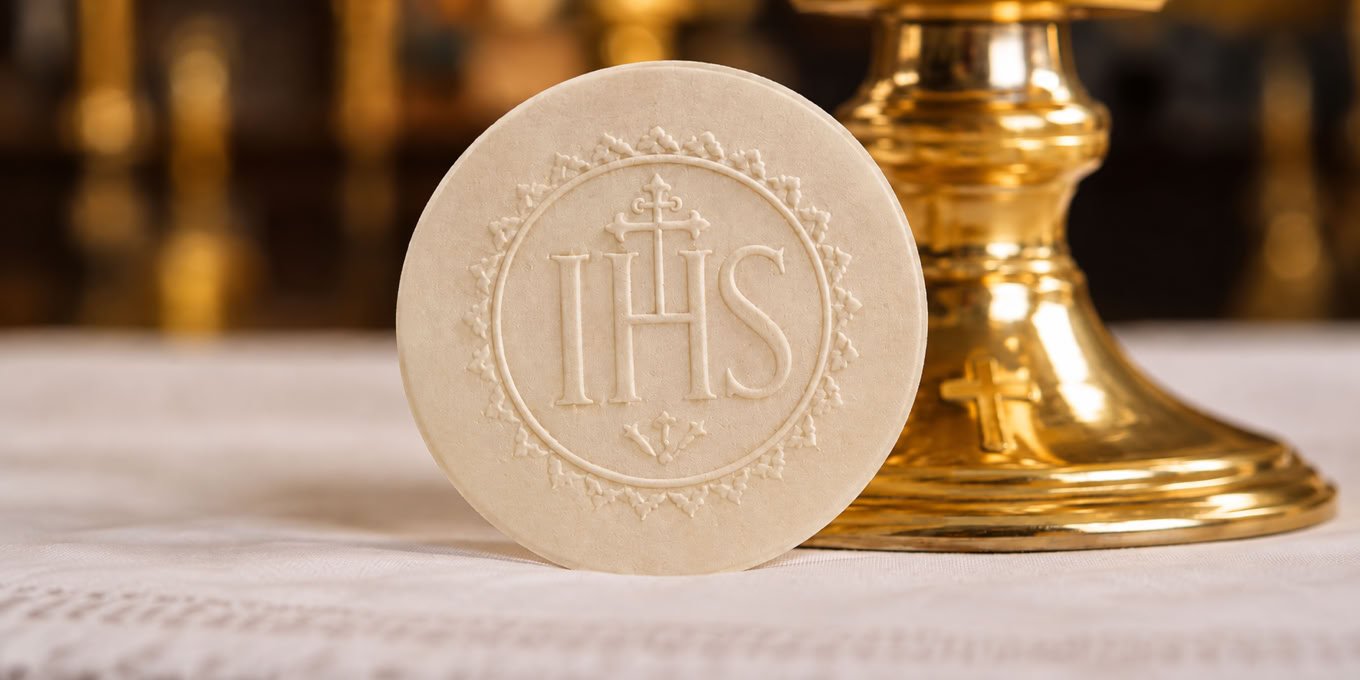
The letters IHS are actually the initials of the Egyptian gods Isis, Horus, and Seb
Wait a minute, I thought we worshipped Mary. Or statues. Or statues of Mary. But apparently we actually worship Isis, Horus, and Seb—and have secretly advertised the fact for centuries by putting their initials on the Eucharist. That sounds hard to believe, but it must be true, because Alexander Hislop says so in his book The Two Babylons:
But let a Roman worshipper of Isis (for in the age of the emperors there were innumerable worshippers of Isis in Rome) cast his eyes upon them, and how will he read them? He will read them, of course, according to his own well known system of idolatry: “Isis, Horus, Seb,” that is, “The Mother, the Child, and the Father of the gods,”—in other words, “The Egyptian Trinity.” Can the reader imagine that this double sense is accidental? Surely not.1
Surely not. Well, yeah, actually it is.
I hate to deflate such a marvelously paranoid theory, but the real origin of the symbol is considerably less exotic. IHS is a Christian abbreviation of the Greek name for Jesus, Ἰησοῦς (Iēsous). In Greek capitals, the name begins ΙΗΣ—the letters iota, eta, and sigma—from which the familiar IHS derives. In other words, “IHS” isn’t an acronym whose three letters need to be assigned separate meanings; they are simply the first three letters of Jesus’ name in Greek.
According to the 1917 Catholic Encyclopedia:
From the third century the names of our Saviour are sometimes shortened, particularly in Christian inscriptions (IH and XP, for Jesus and Christus). In the next century the “sigla” (chi-rho) occurs not only as an abbreviation but also as a symbol. From the beginning, however, in Christian inscriptions the nomina sacra, or names of Jesus Christ, were shortened by contraction, thus IC and XC or IHS and XPS for Iesous Christos. These Greek monograms continued to be used in Latin during the Middle Ages. … Towards the close of the Middle Ages IHS became a symbol, quite like the chi-rho in the Constantinian period.2
Lest you think that’s just Catholic propaganda, I found the following in The Lutheran Witness:
The most common but perhaps least understood monogram often appears in Lutheran churches in the chancel or on the altar itself: “IHS.” It is simply the first three Greek characters in the name “Jesus.”3
I also found this from the United Methodist Church:
IHS are the first three letters of the name “Jesus” in Greek. This is Iota (I), Eta (H in capitalized form in Greek), Sigma (S).4
I have personally seen this symbol used at Methodist, Presbyterian, and non-denominational churches. Maybe you’ve seen it in your church, too. The symbol clearly isn’t distinctively Catholic. It has been used by Catholics and Protestants alike, and it has nothing whatsoever to do with Isis, Horus, and Seb.
__________
1 Alexander Hislop, The Two Babylons, chapter IV, https://www.cbcg.org/twobaby/sect43.html.
2 R. Maere, “IHS,” Catholic Encyclopedia, Encyclopedia Press, Inc., 1913, https://www.newadvent.org/cathen/07649a.htm
3 “Monograms, Christograms, and Initialisms,” The Lutheran Witness, https://witness.lcms.org/2021/monograms-christograms-and-initialisms/
4 “What do the letters IHS stand for?”, The United Methodist Church, https://www.umc.org/en/content/ask-the-umc-what-do-the-letters-ihs-stand-for
Featured Articles
Copyright © 2024–[YEAR] Catholicoutlook.me