Common Objections
Common Objections

Common Objections

The Inquisition proves the Catholic Church can't be Christ's Church
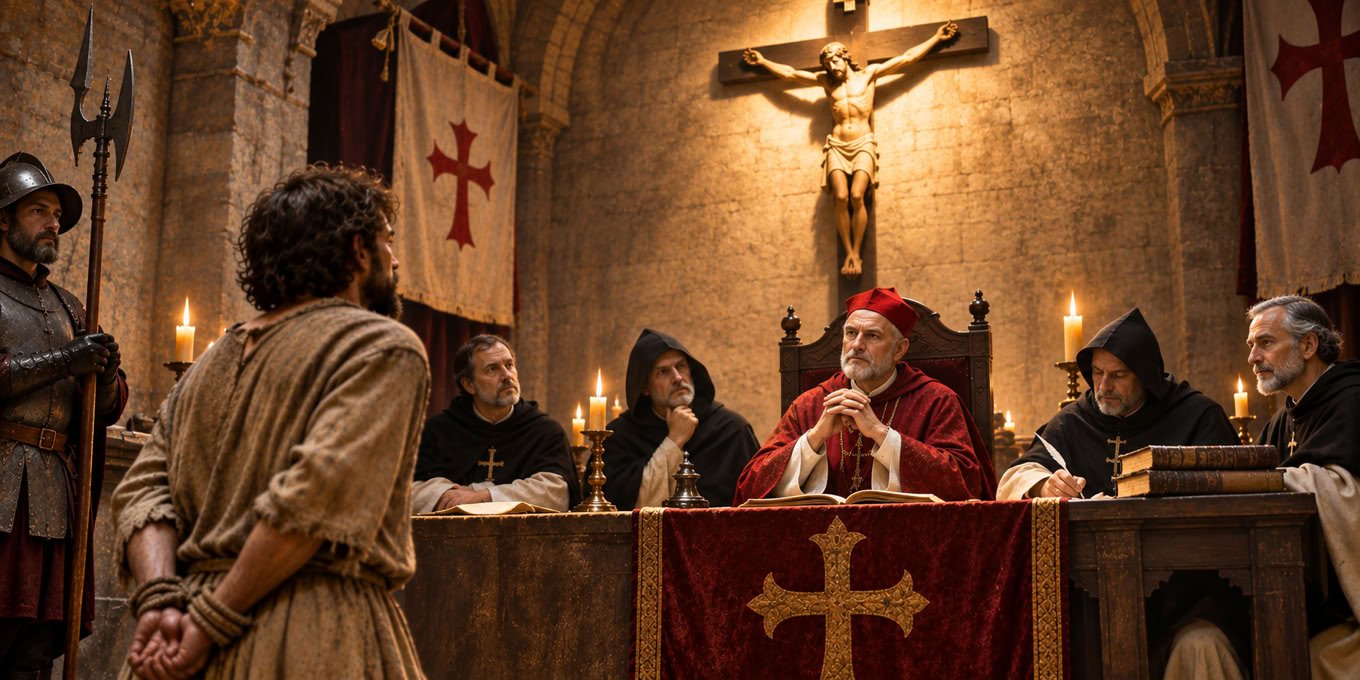
The Inquisition is one of the darkest chapters in Catholic history. People were imprisoned, tortured, and sometimes executed for their religious beliefs, often with the cooperation of Church authorities. How could a Church responsible for such things possibly claim to have been founded by Jesus Christ?
It’s a fair question. And I won’t pretend the abuses never happened or that they weren’t as bad as people say. Some popular accounts exaggerate the Inquisition’s brutality, but the truth is bad enough without exaggeration.1
Understanding the past
What some people don’t realize is that religious persecution wasn’t uniquely Catholic. Protestant authorities also persecuted Catholics and other Protestants, sometimes imprisoning or executing people for their religious beliefs.
We may not be able to condone what our ancestors did, but perhaps we can try to understand it.
People living back then had a very different attitude toward heresy than we do. In the Middle Ages, society was organized around religion to an extent that’s difficult for us to imagine today. Heresy wasn’t seen as simply a matter of personal sin or ignorance, but as a threat to the public order. To challenge established religious beliefs was often seen as a challenge to the state and the common good.2
This attitude continued through the Reformation, when Catholic and Protestant authorities alike persecuted religious dissenters, including members of their own communities. Where Catholics held political power, Protestants could be persecuted. Where Protestants held power, Catholics and other Protestants could suffer the same fate.3
Consider the Anabaptists, who rejected infant baptism. In Protestant Zurich, the authorities made rebaptism a capital offense, and in 1527 Felix Manz was executed by drowning. His persecutors weren’t Catholics. They were fellow Protestants who disagreed with him about baptism.4
The point is that religious persecution wasn’t something peculiar to Catholicism or Protestantism. Both sides inherited a world in which enforcing religious conformity was widely considered a legitimate responsibility of government. The extent of persecution depended heavily on who possessed political power and the means to enforce it.
Understanding the historical circumstances doesn’t baptize persecution and make it Christ-like. But it helps explain how people who sincerely believed they were defending Christianity could commit acts so contrary to the teachings of Christ.
Does this disprove the Church’s claims?
Now let’s examine the assumption behind the accusation. Why would atrocities committed by members of a Church prove that it couldn’t be Christ’s Church? What exactly is the connection?
The Catholic Church claims that Jesus Christ founded it and promised to guide it into all truth (John 16:13), not that he promised to force its members to behave.
Popes, bishops, priests, and laypeople have always been free to sin, and they all have. Some have also abused their authority and even committed terrible wrongs. But that doesn’t mean Christ failed to keep his promise. He promised to guide his Church in what it teaches, not to control how its members behave.
And this isn’t something peculiar to Catholicism. There has never been a Christian Church, Catholic or Protestant, whose members were exempt from the human condition. Every Christian community has been composed entirely of sinners, and some of those sinners have committed terrible wrongs.
None of this excuses what happened. But it does expose the flaw in the accusation.
The Inquisition proves that members of the Catholic Church have sometimes committed terrible sins. It doesn’t prove that Christ never founded the Church, failed to guide it into truth, or abandoned it.
Those conclusions simply don’t follow from the premise.
__________
1 Henry Kamen, The Spanish Inquisition: A Historical Revision (New Haven: Yale University Press, 1997). Kamen reassesses the historical record and challenges exaggerated popular accounts of the Spanish Inquisition.
2 Encyclopaedia Britannica, “Heresy.” Discussion of the treatment of heresy in medieval Christianity and its relationship to ecclesiastical and civil authority.
3 Library of Congress, Religion and the Founding of the American Republic, “America as a Religious Refuge: The Seventeenth Century,” section “European Persecution.” The Library of Congress explains that Catholics and Protestants alike believed civil authorities had a duty to enforce religious uniformity, and that both persecuted dissenters when they controlled political power.
4 Staatsarchiv des Kantons Zürich (State Archives of Zurich), B VI 251, fols. 40r–41v, “Verurteilung des Zürcher Täufers Felix Manz zum Tod durch Ertränken,” January 5, 1527. The original court record documents Manz’s condemnation to death by drowning. See also German History in Documents and Images, “The Birth of Anabaptism—Report on Early Rebaptisms (January 30–February 7, 1525).”
Featured Articles
Copyright © 2024–[YEAR] Catholicoutlook.me