The Church
The Church
The Church

Christianity Before Constantine
Was the early Church Catholic or Protestant?
Introduction
Some Christians believe that the Catholic Church originated with the Roman emperor Constantine, following the Edict of Milan in 313, which granted Christianity legal recognition and religious freedom. According to this view, the Church gradually abandoned the simple Christianity of the apostles and adopted doctrines and practices borrowed from paganism. The Protestant Reformation was therefore a restoration of the original Christian faith.
Protestant author Loraine Boettner expressed this view in his book Roman Catholicism, arguing that large numbers of pagan converts introduced their former religious practices into Christianity until the Church became more pagan than Christian.1
Other Protestant writers place the beginning of Catholicism somewhat later. Fritz Ridenour, for example, identifies the fifth-century papacy of Leo I as an important turning point, arguing that the Western Church increasingly adopted doctrines unsupported by Scripture.2
There’s an interesting problem with the first theory. The contents of the New Testament we have today were not universally settled until well after Constantine. Those books had already been written, of course, but Christians disagreed about which books belonged in the New Testament. Some questioned books such as James, Hebrews, Jude, and Revelation, while others accepted writings such as The Shepherd of Hermas as Scripture.
The fourth-century councils that recognized the New Testament canon operated within the same Church that Boettner describes as having become more pagan than Christian. If that Church had already abandoned the apostolic faith, why should we trust its judgment about which books belong in the New Testament?
Even Martin Luther acknowledged that Protestants had received the Word of God from the Catholic Church, and that without the Church they would have no knowledge of it at all.3
But there’s a more fundamental problem with the theory of a primitive Protestant Church that gradually became Catholic: It doesn’t agree with what the earliest Christians actually believed.
We have a substantial body of Christian literature from the first three centuries, written long before Constantine. Some of these writers knew the apostles personally, while others were taught by people who did.
These weren’t people trying to reconstruct apostolic Christianity two thousand years after the fact. They lived much closer to the apostles than we do. Many spoke the Greek in which the New Testament was written, understood the culture in which it originated, and had opportunities to learn from people who knew the apostles. Surely their understanding of what the apostles taught deserves serious consideration.
That doesn’t mean they were infallible. They could misunderstand Scripture just as we can. But if we’re trying to determine what the apostles taught, wouldn’t it make sense to consider the testimony of Christians who lived closest to them?
And there’s another consideration. When we find substantially the same beliefs among Christians living in different parts of the Roman Empire, that suggests something more than the peculiar teachings of one local congregation.
What we discover is remarkable. These early Christians taught many of the same doctrines that some Protestants regard as later Catholic inventions.
My purpose here is not to prove these doctrines from Scripture. It is to determine whether they were later additions to Christianity. If the Catholic Church invented them centuries after the apostles, we should not find them being taught by Christians who lived during the first, second, and third centuries.
But we do.
The name “Catholic”
The word Catholic comes from the Greek katholikos, meaning “universal.” It was used to describe the Christian Church long before Constantine.
The earliest surviving use of the term in Christian literature appears in a letter written by Ignatius, bishop of Antioch, around AD 110. Ignatius wrote while being taken to Rome for martyrdom. In his Letter to the Smyrnaeans, he declared:
Let no one do anything of concern to the Church without the bishop. Let that be considered a valid Eucharist which is celebrated by the bishop or by one whom he ordains. Wherever the bishop appears, let the people be there; just as wherever Jesus Christ is, there is the Catholic Church.4
Only a few decades later, the account of Polycarp’s martyrdom, written by Christians at Smyrna, described him as:
The wonderful martyr Polycarp, who in our days was an apostolic and prophetic teacher, bishop of the Catholic Church in Smyrna.5
By the beginning of the fourth century, Lactantius was using the term to distinguish the true Church from heretical groups:
It is, therefore, the Catholic Church alone which retains true worship. This is the fountain of truth; this, the domicile of faith; this, the temple of God.6
Now, the mere use of the word Catholic doesn’t establish that the early Church held every doctrine taught by the Catholic Church today. The word originally meant universal, and Protestants are quite right to point that out.
But notice how these writers understood the Church they called Catholic. It wasn’t simply an invisible fellowship of believers who happened to agree about Jesus. It was a recognizable community with bishops, established worship, and a distinction between the Church and groups that had departed from its teaching.
Protestant historian J. N. D. Kelly made this point in his Early Christian Doctrines. He explained that by the latter half of the second century, Catholic distinguished the true Church from heretical congregations, and that the early Christians generally understood the Church as a visible society rather than the invisible fellowship emphasized by some later Protestants.7
So the significance isn’t merely that Christians were using the name Catholic around AD 110. It’s that they were already describing a visible, organized Church that looks considerably more like the Catholic Church than the independent congregations familiar to many American evangelicals.
Church authority and apostolic succession
Catholics believe that Jesus entrusted authority to his apostles, who passed that authority to their successors. This is the doctrine of apostolic succession. Catholics also believe that the bishop of Rome, as Peter’s successor, has a special responsibility for the unity of the Church.
Were these ideas invented centuries after the apostles?
Around the end of the first century, Clement, a leader of the Church at Rome, wrote to the Christians at Corinth concerning a dispute in which some of their legitimate leaders had been removed. He explained that the apostles had made provision for successors to the men they appointed:
Our apostles knew through our Lord Jesus Christ that there would be strife for the office of bishop. For this reason, therefore, having received perfect foreknowledge, they appointed those who have already been mentioned and afterwards added the further provision that, if they should die, other approved men should succeed to their ministry.8
In the same letter, Clement warned the Corinthians about disregarding his instructions:
If anyone disobey the things which have been said by him [God] through us, let them know that they will involve themselves in transgression and in no small danger.9
Think about what’s happening here. Near the end of the first century, the Church of Rome is intervening in the internal affairs of another Christian community hundreds of miles away. And Clement isn’t simply offering a friendly suggestion. He’s warning that disobedience carries serious spiritual consequences.
That doesn’t establish the full Catholic doctrine of papal authority. But it certainly raises questions about the idea that the earliest churches were completely independent congregations with no authority beyond their own interpretation of Scripture.
A few years later, Ignatius of Antioch described the authority of bishops, priests, and deacons in his Letter to the Trallians:
In like manner let everyone respect the deacons as they would respect Jesus Christ, and just as they respect the bishop as a type of the Father, and the presbyters as the council of God and college of the apostles. Without these, it cannot be called a Church.10
By around AD 180, Irenaeus, bishop of Lyons in what is now France, appealed to apostolic succession as a way of distinguishing authentic Christian teaching from heresy:
[I]t is incumbent to obey the presbyters who are in the Church—those who, as I have shown, possess the succession from the apostles; those who, together with the succession of the episcopate, have received the infallible charism of truth, according to the good pleasure of the Father.11
Irenaeus also singled out the Church at Rome, arguing that other churches should agree with it because of its special relationship to the apostles and its preservation of apostolic Tradition.12
Writing in the middle of the third century, Cyprian of Carthage spoke of Peter’s special place among the apostles and of the unity of the Church represented by his chair.13
These writers lived in different regions of the Roman Empire and wrote at different times. Yet they described a Church with bishops, recognized teaching authority, and succession from the apostles.
We can debate how far that authority extended, particularly in the case of the bishop of Rome. But the basic ideas of episcopal government, apostolic succession, and a visible, authoritative Church were clearly not medieval inventions.
Baptism
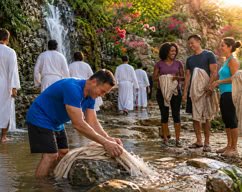
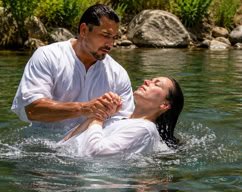
Many American evangelicals regard baptism primarily as a symbolic testimony of faith. Catholics believe that baptism is ordinarily the means by which God forgives sins and brings about spiritual regeneration.
Which understanding do we find among the earliest Christians?
Baptismal regeneration
Around the middle of the second century, Justin Martyr described Christian baptism in his First Apology:
Then they are brought by us where there is water and are regenerated in the same manner in which we were ourselves regenerated. For, in the name of God, the Father . . . and of our Savior Jesus Christ, and of the Holy Spirit, they then receive the washing with water.14
Near the end of the second century, Clement of Alexandria described baptism as:
A washing by which we are cleansed of sins, a gift of grace by which the punishments due our sins are remitted, an illumination by which we behold that holy light of salvation.15
Writing in the early third century, Tertullian was equally explicit:
Baptism itself is a corporal act by which we are plunged into the water, while its effect is spiritual, in that we are freed from our sins.16
Notice that these writers didn’t regard baptism as merely an outward symbol of something God had already accomplished. They believed that God actually did something through baptism.
And this wasn’t a belief confined to one community. Justin wrote in Rome, Clement in Alexandria, and Tertullian in Carthage. By the second and early third centuries, Christians in widely separated regions were describing baptism in substantially the same way.
That doesn’t prove that their understanding was correct. But it does make it difficult to maintain that baptismal regeneration was a doctrine invented centuries later by the Catholic Church.
Infant baptism
Some Protestants baptize infants, while others insist that baptism should be reserved for those old enough to make a personal profession of faith.
But infant baptism was practiced centuries before Constantine.
Origen, writing in the third century, explained:
In the Church baptism is given for the remission of sins, and, according to the usage of the Church, baptism is given even to infants. If there were nothing in infants which required the remission of sins and nothing in them pertinent to forgiveness, the grace of baptism would seem superfluous.17
More significantly, Origen expressly attributed the practice to the apostles:
The Church received from the apostles the tradition of giving baptism even to infants.18
Now, Origen’s assertion that infant baptism came from the apostles doesn’t prove that it did. But he was writing only about two centuries after Christ, and he described the practice as something the Church had received, not something recently introduced.
At the very least, his testimony establishes that infant baptism was already an established Christian practice long before Constantine.
And it raises an interesting question: If infant baptism was an unauthorized innovation, when and where did it originate, and why did Christians come to believe it had been handed down by the apostles?
Confession and serious sin
Catholics believe that Christ gave his Church authority to forgive sins and that Christians can forfeit their salvation through serious, unrepented sin.
These beliefs, too, have roots in the earliest Christian literature.
Confession of sins
The Didache, an early Christian manual of instruction and worship dating from the late first or early second century, commands:
Confess your sins in church, and do not go up to your prayer with an evil conscience.19
That doesn’t necessarily describe the individual confession to a priest familiar to Catholics today. But it does show that confession was part of the Church’s life from a remarkably early date.
By the third century, however, Christian writers were explicitly describing confession to priests. Origen, in his Homilies on Leviticus, wrote:
[A final method of forgiveness], albeit hard and laborious, [is] the remission of sins through penance, when the sinner . . . does not shrink from declaring his sin to a priest of the Lord and from seeking medicine.20
Cyprian of Carthage similarly urged Christians in his treatise On the Lapsed to:
Confess their sins to the priests of God in a straightforward manner and in sorrow, making an open declaration of conscience.21
The precise form of sacramental confession developed over the centuries. But the idea that Christians should confess their sins and seek reconciliation through the ministry of the Church was not something invented in the Middle Ages.
Mortal sin and the loss of salvation
Many American evangelicals believe that once someone has genuinely been saved, he can never lose his salvation. Catholics believe that a Christian can turn away from God through serious, unrepented sin.
What did the early Christians believe?
The Shepherd of Hermas, a widely read Christian work from the second century, warns:
As many as do not repent at all, but abide in their deeds, shall utterly perish. . . . But if any one relapse into strife, he will be cast out of the tower [the Church], and will lose his life.22
Toward the end of the second century, Irenaeus described eternal life as God’s gift to those who persevered:
[He] may, in the exercise of His grace, confer immortality on the righteous, and holy, and those who have kept His commandments, and have persevered in His love, some from the beginning [of their Christian life], and others from [the date of] their penance.23
These passages don’t settle every question about salvation and perseverance. But they certainly don’t sound like assurances that a Christian’s salvation is permanently secure regardless of whether he subsequently abandons the faith.
The early Christians took seriously the possibility of falling away. And they understood repentance and perseverance as matters with eternal consequences.
Prayer to the saints and for the dead
Catholics believe that the saints in heaven continue to pray for Christians on earth, that we may ask for their intercession, and that our prayers can benefit the faithful departed.
Many evangelicals regard these beliefs as later additions to Christianity. But once again, the historical evidence tells a more complicated story.
The intercession of the saints
Around the beginning of the third century, Clement of Alexandria described the Christian at prayer:
He also prays in the society of angels, as being already of angelic rank, and he is never out of their holy keeping; and though he pray alone, he has the choir of the saints standing with him.24
Origen was more explicit in his treatise On Prayer:
But not the high priest [Christ] alone prays for those who pray sincerely, but also the angels . . . as also the souls of the saints who have already fallen asleep.25
And Cyprian, writing to another bishop in the middle of the third century, expressed the hope that their prayers for one another would continue even after one of them died:
Let us on both sides always pray for one another. . . . If one of us . . . shall go hence the first, our love may continue in the presence of the Lord, and our prayers for our brethren and sisters not cease in the presence of the Father’s mercy.26
Notice what these writers believed: Christians who had died were not cut off from the rest of the Church. They continued to live in God’s presence and could continue praying for their brothers and sisters on earth.
Now, these passages don’t establish that Christians were already addressing requests for intercession directly to departed saints. That practice is documented more explicitly in later sources.
But they do establish something important: the belief that the departed faithful intercede for the living was present centuries before Constantine.
And that belief is one of the foundations of the Catholic practice of asking the saints for their prayers.
Prayer for the dead
The practice of praying for deceased Christians also appears remarkably early.
The epitaph of Abercius, a Christian bishop of the late second century, concludes with a request:
May everyone who is in accord with this and who understands it pray for Abercius.27
Writing in the early third century, Tertullian described a Christian widow who prayed for her deceased husband:
A woman, after the death of her husband . . . prays for his soul and asks that he may, while waiting, find rest; and that he may share in the first resurrection. And each year, on the anniversary of his death, she offers the sacrifice.28
Why would Christians pray for the dead if they believed such prayers could accomplish nothing?
Catholics understand this practice in connection with the possibility that those who die in God’s grace may still need purification before entering heaven.
Of course, these early references don’t establish the fully developed Catholic doctrine of purgatory. But they do establish that Christians were praying for the dead long before the medieval period.
Whatever one thinks of the practice, it certainly wasn’t invented by medieval Catholics.
The Eucharist
Catholics believe that the Eucharist is truly the body and blood of Jesus Christ and that the Mass makes present his one sacrifice on Calvary.
Many evangelicals, on the other hand, regard the Lord’s Supper primarily as a symbolic memorial of Christ’s death.
Which understanding resembles that of the earliest Christians?
The Real Presence
Around AD 110, Ignatius of Antioch condemned certain heretics because:
They abstain from the Eucharist and from prayer because they do not confess that the Eucharist is the flesh of our Savior Jesus Christ, flesh which suffered for our sins and which the Father, in his goodness, raised up again.29
That’s a remarkable statement.
Ignatius wasn’t merely expressing a private opinion about the Eucharist. He regarded denial that the Eucharist was Christ’s flesh as a mark of heresy.
And remember when he was writing: around AD 110, within living memory of the apostles.
About forty years later, Justin Martyr described the Eucharist:
For not as common bread nor common drink do we receive these; but since Jesus Christ our Savior was made incarnate by the word of God and had both flesh and blood for our salvation, so too, as we have been taught, the food which has been made into the Eucharist by the Eucharistic prayer . . . is both the flesh and blood of that Incarnated Jesus.30
Justin was describing Christian worship in Rome, while Ignatius had served as bishop in Antioch.
Here again, we find substantially similar beliefs among Christians in different parts of the Roman Empire.
Neither writer presented the Real Presence as a recent innovation. Both described it as part of the Christian faith they had received.
This doesn’t establish every detail of the later Catholic explanation of the Eucharist. But it certainly challenges the idea that the earliest Christians regarded the Lord’s Supper as merely a symbolic memorial.
The sacrifice of the Mass
Catholics don’t believe that Christ is sacrificed again at every Mass. They believe that his one sacrifice on Calvary is made present sacramentally.
But did the earliest Christians understand the Eucharist as a sacrifice, or simply as a meal commemorating Jesus’ death?
The Didache, written in the late first or early second century, instructed Christians:
Assemble on the Lord’s day, and break bread and offer the Eucharist; but first make confession of your faults, so that your sacrifice may be a pure one.31
Ignatius of Antioch also used sacrificial language:
Make certain, therefore, that you all observe one common Eucharist; for there is but one Body of our Lord Jesus Christ, and but one cup of union with his Blood, and one single altar of sacrifice.32
Around the middle of the second century, Justin Martyr identified the Eucharist with the pure offering foretold by the prophet Malachi:
He then speaks of those Gentiles, namely us [Christians] who in every place offer sacrifices to him, that is, the bread of the Eucharist and also the cup of the Eucharist.33
And Irenaeus, writing toward the end of the second century, made the same connection:
He taught the new sacrifice of the new covenant, of which Malachi, one of the twelve [minor] prophets, had signified beforehand.34
Notice the progression. The Didache speaks of the Eucharist as a sacrifice. Ignatius associates it with an altar. Justin and Irenaeus connect it with the sacrifice foretold by Malachi.
And all of this was written within approximately the first two centuries of Christianity.
These quotations don’t by themselves establish the complete Catholic theology of the Mass. But they demonstrate that sacrificial language was associated with the Eucharist long before Constantine.
If the earliest Christians understood the Lord’s Supper as nothing more than a symbolic memorial, this is a rather surprising way for them to describe it.
Scripture and Tradition
Many American evangelical Protestants believe that the Bible is the Christian’s only rule of faith and practice. Catholics believe that the apostles transmitted their teachings both in writing and orally, and that the Church preserves this apostolic Tradition alongside Scripture.
Which approach do we find in the earliest Christian writings?
Irenaeus, writing toward the end of the second century, appealed to the Tradition preserved in the churches founded by the apostles:
What if the Apostles had not in fact left writings to us? Would it not be necessary to follow the order of Tradition, which was handed down to those to whom they entrusted the Churches?35
That’s an interesting question, particularly for someone who believes that all Christian doctrines must be established from Scripture alone.
Irenaeus clearly regarded the teaching handed down through the apostolic churches as a reliable means of knowing what the apostles had taught, even apart from their writings.
Origen likewise described the Church’s teaching as something received through an unbroken succession:
The teaching of the Church has indeed been handed down through an order of succession from the Apostles and remains in the churches even to the present time. That alone is to be believed as the truth which is in no way at variance with ecclesiastical and Apostolic Tradition.36
More than a century later, Basil the Great expressed the relationship between Scripture and Tradition in unmistakable terms:
Of the dogmas and messages preserved in the Church, some we possess from written teaching and others we receive from the Tradition of the Apostles, handed on to us in mystery. In respect to piety both are of the same force.37
Basil’s testimony is later than the others, but it illustrates the continued importance Christians attached to unwritten apostolic Tradition.
These writers certainly revered Scripture as the inspired Word of God. But they didn’t regard the written Scriptures as the only means by which authoritative apostolic teaching had been transmitted.
They believed that the Church had received teachings from the apostles and had a responsibility to preserve them.
That doesn’t mean every tradition subsequently claimed by Christians necessarily originated with the apostles. Such claims still have to be examined.
But it does mean that the idea of preserving apostolic teaching outside the written Scriptures was not a medieval Catholic invention. It was part of how Christians understood their faith long before Constantine.
Conclusion: Restoration or distortion?
What have we discovered?
Long before Constantine, Christians called their Church Catholic. They believed in apostolic succession, episcopal authority, baptismal regeneration, infant baptism, confession of sins, the possibility of losing salvation, the intercession of the saints, prayer for the dead, the Real Presence of Christ in the Eucharist, the Eucharistic sacrifice, and the authority of apostolic Tradition.
These beliefs weren’t confined to one isolated community. We find them in the writings of Christians living in different centuries and in different parts of the Roman Empire. And these writers generally didn’t present their teachings as innovations. They believed they were preserving the faith handed down by the apostles.
This presents a serious problem for the claim that the Protestant Reformation restored the original Christian faith.
Consider the doctrine of forensic justification, the Reformation teaching that God justifies sinners by crediting Christ’s righteousness to them.
Prominent evangelical apologists Norman Geisler and Ralph MacKenzie, both defenders of justification by faith alone, acknowledged that between the apostle Paul and the Protestant Reformation, “scarcely anyone taught imputed righteousness (or forensic justification) during that period!”38
Geisler and MacKenzie believed the Reformers had recovered a biblical doctrine that had been lost. But that assumes it was there to begin with. And how could it have been lost when it was right there in the Bible all along? It’s not as though the Reformers discovered a lost letter from Paul. They were reading the same Scriptures Christians had been reading for fifteen centuries. Are we to believe that generations of Christians, including those who lived closest to the apostles, had somehow failed to understand one of the most fundamental teachings of the gospel, only to have it finally recognized during the Reformation?
Of course, a biblical teaching can be misunderstood even when the text containing it remains available. But when a doctrine supposedly central to Christianity is largely absent from the surviving record of Christian teaching for fifteen centuries, shouldn’t we at least consider the possibility that the doctrine, rather than the Christians who failed to recognize it, might be mistaken?
And the problem isn’t limited to justification. If the Reformers were right about the doctrines they rejected, then Christians who inherited their faith from the apostles must have misunderstood some of the most fundamental teachings of Christianity.
Former evangelical Mark Shea observed that this would mean believing that the apostles—all of them—produced thousands of students who couldn’t grasp the most basic teachings of their faith. It would mean believing that within a generation or two, Christianity had been thoroughly corrupted—and corrupted in much the same ways throughout the length and breadth of the Roman Empire. And it would mean believing that somehow, while the faith once delivered to the saints was being corrupted, none of those saints seemed to notice.39
Where is the evidence of this extraordinary transformation? Where are the Christian communities that preserved the original faith? Where are their bishops, teachers, and writings?
But there’s an even more fundamental problem. Jesus promised that the gates of hell would not prevail against his Church (Matthew 16:18). He promised to remain with his followers always, to the end of the age (Matthew 28:20). And Paul called the Church—not the Bible—the “pillar and foundation of the truth” (1 Timothy 3:15).
How can those promises be reconciled with the idea that the Church almost immediately abandoned the true gospel and didn’t recover it until the sixteenth century?
That isn’t to say that the Church in Luther’s day was without problems. It certainly needed reform, particularly in its moral and disciplinary practices. But reforming abuses is one thing; replacing doctrines inherited from the earliest centuries of Christianity is quite another.
The historical evidence points to a conclusion very different from the one offered by those who believe Constantine or some later pope invented Catholicism.
The early Church was recognizably Catholic, both in name and in many of its beliefs and practices. Those beliefs didn’t suddenly appear in the fourth or fifth century. They were already present when Christianity was still a persecuted religion, long before it enjoyed the favor of Roman emperors.
If we’re looking for the origins of the Catholic Church, there’s no convincing historical reason to begin with Constantine, Leo I, or any other later figure.
We must go back to the apostles themselves.
And if the Reformation rejected doctrines that Christians had believed and practiced since the earliest centuries, then the question is unavoidable: Was the Reformation really a return to original Christianity, or was it a distortion of it?
__________
1 Loraine Boettner, Roman Catholicism (Philadelphia: Presbyterian and Reformed Publishing Company, 1962), 11. https://www.monergism.com/thethreshold/sdg/boettner/Roman%20Catholicism%20-%20Loraine%20Boettner.pdf
2 Fritz Ridenour, So What’s the Difference? (Ventura, CA: Regal Books, 1967), 29.
3 Martin Luther, Sermons on the Gospel of St. John, Chapters 14–16, in Luther’s Works, vol. 24, ed. Jaroslav Pelikan (St. Louis: Concordia Publishing House, 1961), 304. https://beggarsallreformation.blogspot.com/2006/11/luther-infallible-church-declared.html
4 Ignatius of Antioch, Letter to the Smyrnaeans, 8.2. https://www.newadvent.org/fathers/0109.htm
5 The Martyrdom of Polycarp, 16.2. https://www.earlychristianwritings.com/text/martyrdompolycarp-roberts.html
6 Lactantius, Divine Institutes, 4.30. https://www.newadvent.org/fathers/07014.htm
7 J. N. D. Kelly, Early Christian Doctrines, rev. ed. (San Francisco: Harper & Row, 1978), 190, discussion of the Catholic Church and its visible character.
8 Clement of Rome, First Letter to the Corinthians, 44. https://www.newadvent.org/fathers/1010.htm
9 Clement of Rome, First Letter to the Corinthians, 59. https://www.newadvent.org/fathers/1010.htm
10 Ignatius of Antioch, Letter to the Trallians, 3.1. https://www.newadvent.org/fathers/0106.htm
11 Irenaeus of Lyons, Against Heresies, 4.26.2. https://www.newadvent.org/fathers/0103426.htm
12 Irenaeus of Lyons, Against Heresies, 3.3.2. https://www.newadvent.org/fathers/0103303.htm
13 Cyprian of Carthage, On the Unity of the Catholic Church, 4. https://www.newadvent.org/fathers/050701.htm
14 Justin Martyr, First Apology, 61. https://www.newadvent.org/fathers/0126.htm
15 Clement of Alexandria, The Instructor, 1.6. https://www.newadvent.org/fathers/02091.htm
16 Tertullian, On Baptism, 7. https://www.newadvent.org/fathers/0321.htm
17 Origen, Homilies on Leviticus, 8.3. https://www.churchfathers.org/infant-baptism?utm_source=chatgpt.com
18 Origen, Commentary on Romans, 5.9. https://www.thetbs.org/study-materials/wp-content/uploads/2023/03/Commentary-on-the-Epistle-to-the-Romans-by-Origen-z-lib.org_.pdf
19 Didache, 4.14. https://www.earlychristianwritings.com/text/didache-roberts.html
20 Origen, Homilies on Leviticus, 2.4. https://www.ldysinger.com/%40texts/0250_origen/04_hom2_on_lev.htm
21 Cyprian of Carthage, On the Lapsed, 28. https://www.newadvent.org/fathers/050703.htm
22 The Shepherd of Hermas, passages concerning repentance and exclusion from the tower. https://www.newadvent.org/fathers/0201.htm
23 Irenaeus of Lyons, Against Heresies, 1.10.1. https://www.newadvent.org/fathers/0103110.htm
24 Clement of Alexandria, Stromata, 7.12. https://www.newadvent.org/fathers/02107.htm
25 Origen, On Prayer, 11. https://www.ccel.org/ccel/origen/prayer.vii.html
26 Cyprian of Carthage, Letter 57 (numbering varies by edition), 5. https://www.newadvent.org/fathers/050656.htm
27 Epitaph of Abercius, late second century. https://www.museivaticani.va/content/museivaticani/en/collezioni/musei/lapidario-cristiano/abercio/cippo-di-albercio.html
28 Tertullian, On Monogamy, 10. https://www.newadvent.org/fathers/0406.htm
29 Ignatius of Antioch, Letter to the Smyrnaeans, 7.1. https://www.newadvent.org/fathers/0109.htm
30 Justin Martyr, First Apology, 66. https://www.newadvent.org/fathers/0126.htm
31 Didache, 14.1. https://www.earlychristianwritings.com/text/didache-roberts.html
32 Ignatius of Antioch, Letter to the Philadelphians, 4. https://www.newadvent.org/fathers/0108.htm
33 Justin Martyr, Dialogue with Trypho, 41. https://www.newadvent.org/fathers/01283.htm
34 Irenaeus of Lyons, Against Heresies, 4.17.5. https://www.newadvent.org/fathers/0103417.htm
35 Irenaeus of Lyons, Against Heresies, 3.4.1. https://www.newadvent.org/fathers/0103304.htm
36 Origen, On First Principles, preface, 2. https://www.newadvent.org/fathers/04120.htm
37 Basil the Great, On the Holy Spirit, 27.66. https://www.newadvent.org/fathers/3203.htm
38 Norman L. Geisler and Ralph E. MacKenzie, Roman Catholics and Evangelicals: Agreements and Differences (Grand Rapids: Baker Books, 1995), 503. See also their discussion of forensic justification in “What Think Ye of Rome? Part Five”.
39 Mark Shea, By What Authority? (Huntington, IN: Our Sunday Visitor, 1996), 157.
Featured Articles
Copyright © 2024–[YEAR] Catholicoutlook.me